When you mention the word trends, most people often think of the latest fashion, food, dance moves or popular language/slang. On social media, what’s trending, for example on X (formerly Twitter), refers to a short-lived wave of posts and conversations centred on a hashtag.
Beyond lifestyle fads, there are also business trends, which is how the market is predicted to perform over time. A trend is therefore movement or transformation of something in a certain direction, which can be developing or long-established. Trends research helps its identify observable patterns of gradual change. These movements in a trend may show an upward rise, a sideway shift, or a downward decline.
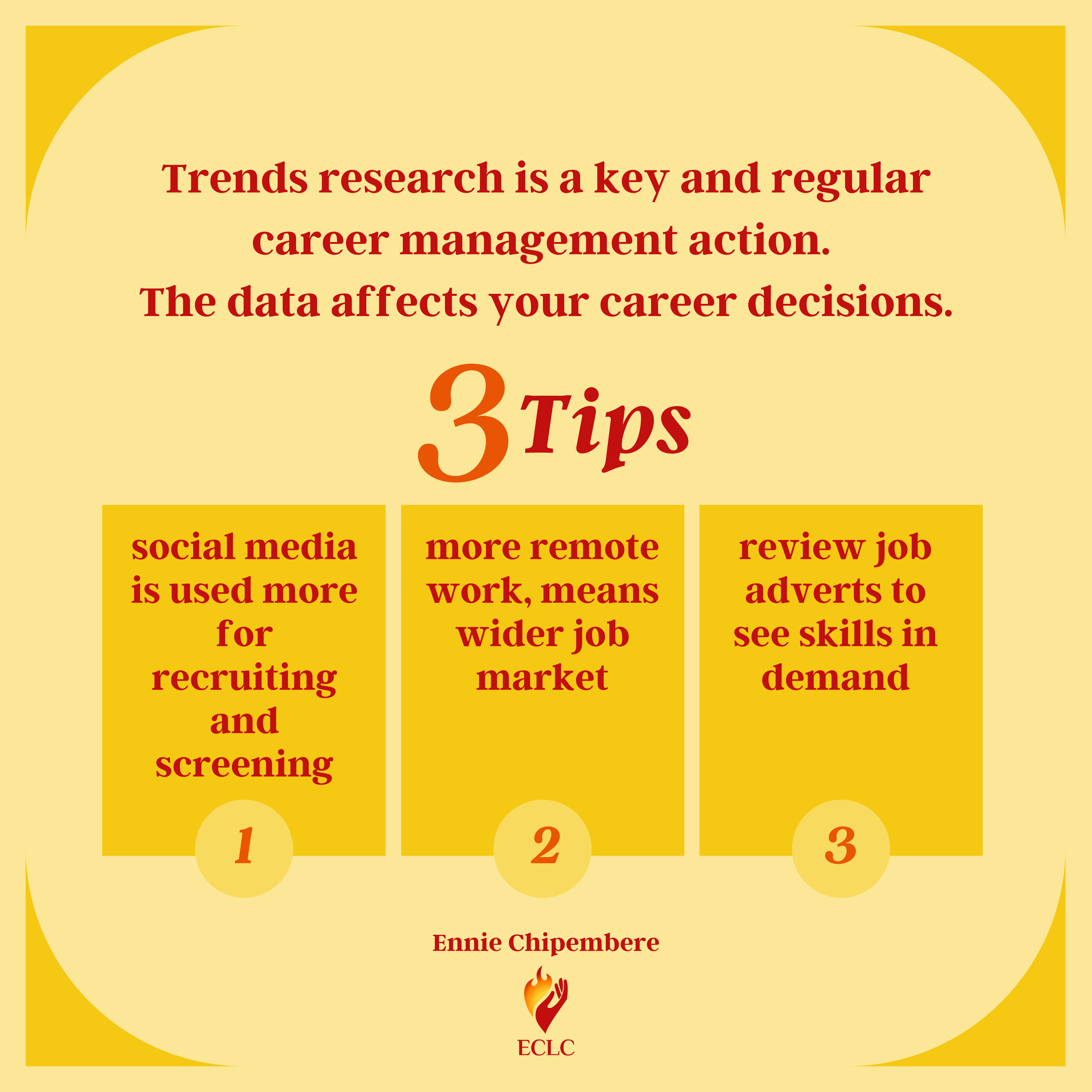
Trends influence our business decisions, personal behaviours and everyday actions. Similarly, rresearching, analysing, and applying trends is a crucial step in career planning and management. Trends analysis is useful in career development or job search because:
- The process of analysing past data helps you to capture lessons and predict future directions.
- It gives you a birds eye-view of information, patterns that can inform further research, decisions, or actions.
- The information helps you to identify opportunities to leverage.
- You can assess yourself against key trends e.g. digital technologies; and identify areas of improvement.
- It is an evidence-based strategy to help you make informed decisions and future-proof your career.
Identifying and analysing trends can directly shape your career actions such as job search, career changes, education choices, retirement planning, career change and learning investment in skills development. This is because, at the heart of making good career decisions and planning for action is having access to the latest information from relevant trends, which will affect your desired goal. Of course, one needs to discern whether something is a “fad”, which is short-lived or a genuine trend, which has a much longer lifespan.
5 Tips to Help You Research Trends for Sound Career Decisions and Actions
Targeted trends research and analysis for career purposes is not something most people do consistently. Many do not know where to start and where to get information. The following 5 tips will help you get started:
TIP 1: Identify, triangulate, and validate information sources
The sources of information for data and insights about trends are everywhere and many and they are around us everyday. The type of data can be both qualitative and quantitative. In the list below, I provide pointers of the sources, which can be local, nation, regional or global. The specifics for each of these will depend on your context and location. This is not an exhaustive list, but it will get you started.
- Research institutes or companies
- Academic publications in peer reviewed journals
- Professional Associations or Sector bodies
- Career services websites including job portals
- Industry Thought Leaders
- Labour Market Information
- Government Statistics reporting bodies
- News channels – TV and newspapers
- Social media – X, LinkedIn, Facebook, Instagram
- Conferences , webinars, and professional events
TIP 2: Follow Thought Leaders in the sector who are Trends Analysts or Predictors
Each industry or sector and profession has got people known as Thought Leaders because they research, write, and share ideas that shapes collective thinking and decision-making. They are recognised for their expertise through publications, awards, social influence, and leadership roles.
For example, I follow Dorie Clark, a thought leader in personal branding, career reinvention, and independent work strategies. I track her insights on LinkedIn and X, subscribe to her newsletter, attend her live sessions, and read her books and Harvard Business Review articles. This ensures I stay updated on the latest thinking relevant to my professional growth.
TIP 3: Conduct a Webquest and Track what is being written and talked about
There is no shortage in today’s information-rich world, the challenge is not scarcity but overload. This means you have to be strategic about the sources of content you track. G
For example, while writing a blog on soft skills, I found that Roberta Neault’s 2012 book Time to Explore highlighted a then-emerging trend, the growing importance of soft (or “essential”) skills over purely technical ones. Years later, this trend has only strengthened. A 2019 Google Scholar search for “soft skills for the 21st century” yielded over 450 scholarly articles, proving its global relevance.
You can also track emerging themes by reviewing conference topics, summit discussions, and industry reports, these often reveal what professionals are talking and writing about most.
TIP 4: Track increased demand or shrinkage in certain jobs and types
The main purpose of career and digital trends research and analysis is to help you stay informed and future-ready. Track whether the types of jobs you’re interested in are growing or shrinking.
Sources include:
-
Labour market reports (e.g. national quarterly employment data)
-
News articles on hiring trends or layoffs
-
Career sites such as Glassdoor, Indeed, LinkedIn, and The Balance Careers
These platforms often publish reports on in-demand skills, emerging roles, and recruitment trends; helping you align your career goals with real-world data.
TIP 5: Tap into your Social and Professional network for Insights and Leads
People remain one of the most valuable sources of insight. Your social and professional network can offer firsthand information about changes, challenges, and opportunities in your field. To benefit from this, you need a strong, active network with “warm” connections; individuals you can engage with meaningfully. Review who’s in your network and identify gaps. Consider which contacts can provide updates, perspectives, or leads about emerging trends in your industry.

Conclusion:
Trend research is not a one-time task. It’s an ongoing habit that should be part of your daily or weekly career routine. Over time, it becomes instinctive, like an entrepreneur constantly scanning for opportunities.
By gathering information from diverse sources and observing consistent patterns, you will gain insights that help you:
-
Identify skills gaps and areas for growth
-
Position yourself strategically for future opportunities
-
Build resilience and adaptability in a changing world
In short, staying informed about trends is one of the most powerful ways to future-proof your career and secure your long-term success.
Good luck!
REFLECTION QUESTION:
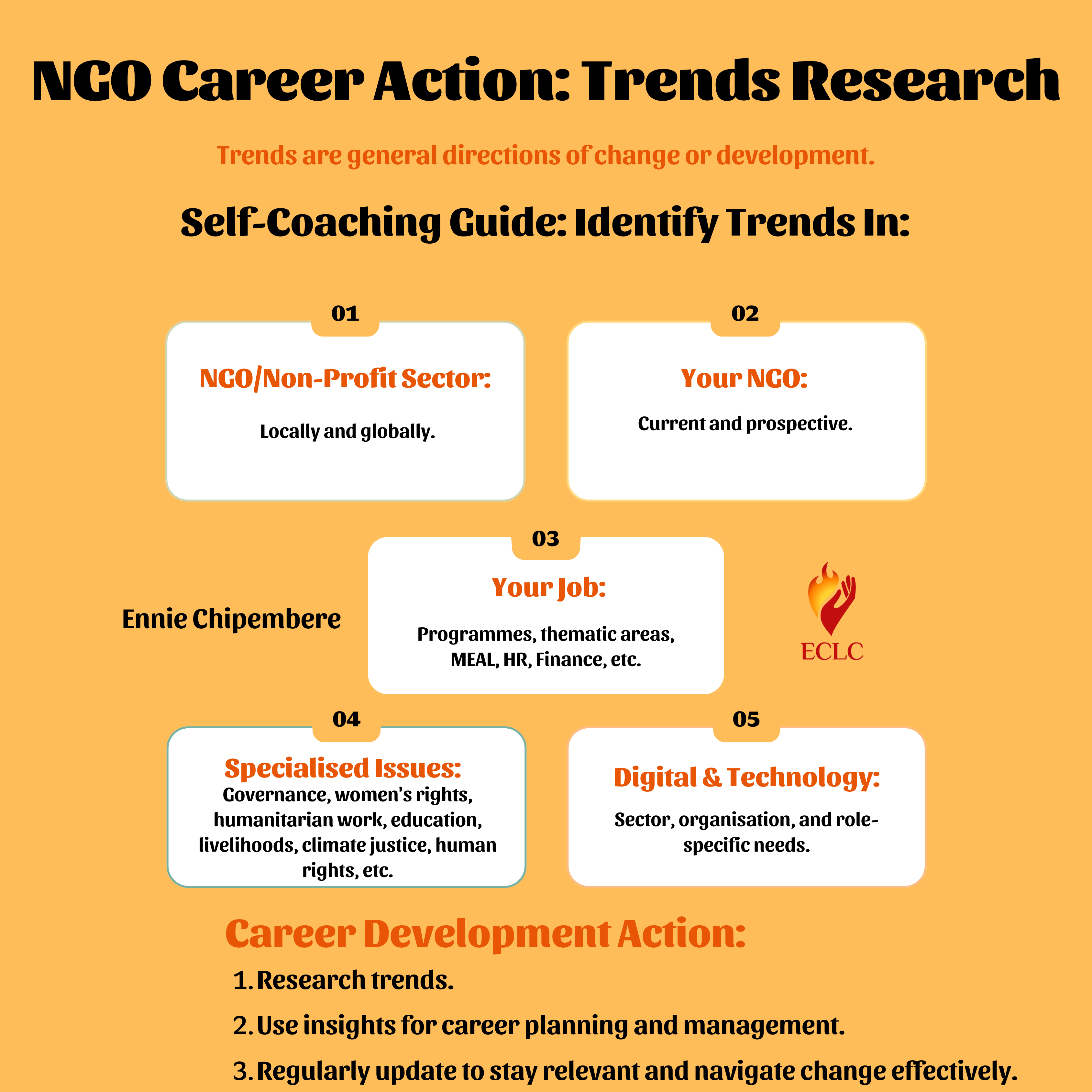
How often do you pause to observe the trends shaping your profession — and intentionally align your career actions with where the world is moving?
JOIN THE COACH ENNIE & ECLC CAREER GROWTH COMMUNITY
Gain access to tools, tips, and a supportive space to explore your values and discover how they align with your life and career journey.
 Join the WhatsApp Community here:
https://chat.whatsapp.com/CI1MEbdzX2G0zMvsZHNvdq
Once inside, join groups that are tailored for your journey:
1. Career Planning, Development and Management
2. Leadership Development and Team Building
3. Wellness-Centred Life Planning and Personal Management
4. NGO Workers: Career Coaching and Advice
5. Job Search and Employability Support

Written by: Ennie Chipembere Chikwema
Coach, NGO Institutional Development Consultant and ECLC Director
E-mail: ennie.chipembere@eclcglobal.com
LinkedIn Profile: https://www.linkedin.com/in/ennie-chipembere-chikwema/
Facebook Page: https://www.facebook.com/EnnieCareerCoach
X: @EnnieChipembere
Discover more from Empowering Coaching, Learning and Consultancy
Subscribe to get the latest posts sent to your email.

Great blog post on the importance of trends research in career planning! As someone who struggled to stay up-to-date with the latest industry developments, I can attest to the value of following thought leaders and conducting webquests. After stumbling upon a conference focused on emerging technologies in my field, I discovered a whole new realm of possibilities and immediately took action to acquire the necessary skills. Thanks to trends research, I was able to future-proof my career and position myself as a valuable asset in a rapidly evolving industry.
LikeLike
Good day! Definitely a different angle on the word Trend there. Noted with thanks!
LikeLike
This article provides insightful tips on conducting trends research for career planning, emphasizing the importance of following thought leaders and using reliable information sources. Your practical advice on identifying genuine trends and leveraging networks for insights is invaluable. Thank you for sharing these useful strategies!
LikeLike
I find the idea of using trends research to inform career decisions very insightful.
LikeLike